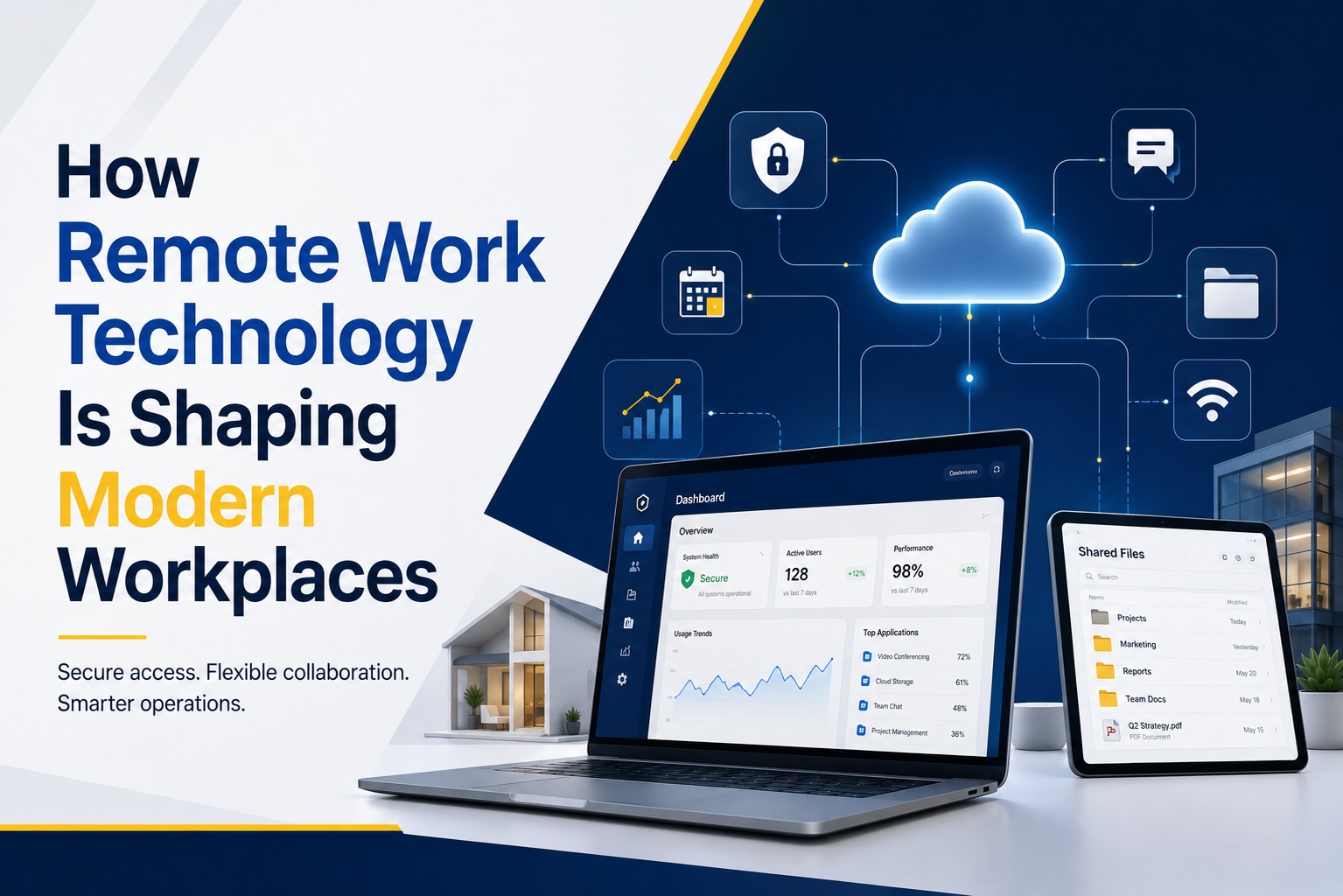
How Remote Work Technology
Is Shaping Modern
Workplaces
Published by Capitol Technology Solutions
Remote Work | Enterprise IT | Collaboration Technology
Remote work has moved well beyond a temporary arrangement.
What began as a crisis response has evolved into a permanent fixture of the modern business landscape. Across industries—from consulting firms and law practices to healthcare organizations and government relations agencies—distributed teams are now the norm rather than the exception. The question is no longer whether remote work will continue but how organizations can leverage the right remote work technology to make it sustainable, secure, and genuinely productive.
At Capitol Technology Solutions, we work with businesses every day that are navigating this exact challenge. From managed IT services to network design and software solutions, we have seen firsthand how the right technology stack can transform a remote team into a high-performing unit. This blog explores the emerging technologies reshaping distributed work and what forward-thinking organizations need to consider as they plan for the future.
The Rise of Advanced Collaboration Tools
The foundation of any successful remote work setup is a reliable and intuitive collaboration platform. Over the past few years, collaboration tools have matured considerably. Platforms like Microsoft Teams, Slack, and Google Workspace have gone far beyond simple messaging. They now offer integrated project management, document co-authoring, task tracking, and seamless third-party app connections that make it possible for distributed teams to operate as cohesively as they would in a shared office.
What makes today's collaboration software particularly powerful is the level of integration it supports. A well-configured digital workplace can connect your communication platform with your CRM, ticketing system, file storage, and scheduling tools so that information flows freely and team members spend less time switching between applications and more time doing meaningful work.
For businesses managing complex workflows across multiple locations, investing in a properly integrated collaboration ecosystem is not optional—it is a core component of operational efficiency. Organizations that treat their digital workplace tools as a collection of disconnected apps often struggle with fragmented communication, duplicated effort, and unnecessary delays. A unified approach, supported by experienced managed IT services, ensures that your tools work together rather than against each other.
Virtual Reality Meetings and Immersive Workspaces
One of the most talked-about developments in remote work technology is the emergence of virtual reality (VR) and augmented reality (AR) meeting environments. While still in the early stages of mainstream adoption, VR collaboration platforms are gaining traction in industries where spatial awareness, interactive presentations, and immersive training experiences matter most.
Platforms like Microsoft Mesh, Spatial, and Meta Horizon Workrooms allow teams to meet as avatars in shared three-dimensional environments. Rather than staring at a grid of video thumbnails, participants can sit around a virtual conference table, interact with 3D models, annotate digital whiteboards, and engage in a way that feels more natural and engaging than a standard video call.
For engineering and construction firms, VR meeting tools open up remarkable possibilities. Teams can walk through building designs in three dimensions before a single brick is laid. For consulting organizations, immersive environments allow for richer client presentations. For training and onboarding in healthcare and government relations settings, simulated scenarios provide learning experiences that flat video simply cannot match.
The infrastructure requirements for VR collaboration are not trivial. Organizations need fast, stable internet connections, robust endpoint security, and devices capable of running immersive applications without lag. This is where a strong network design and managed services foundation becomes critical. Getting the VR experience right depends heavily on getting the underlying IT infrastructure right first.
AI-Driven Productivity Aids Transforming How We Work
Artificial intelligence is now embedded in nearly every category of workplace software, and its impact on remote work productivity is substantial. AI-driven productivity tools are helping distributed teams do more with less friction, from automated scheduling and smart meeting transcription to intelligent document summarization and predictive task management.
AI-powered meeting assistants like Otter.ai, Fireflies, and Microsoft Copilot can transcribe conversations in real time, extract action items, generate summaries, and even suggest follow-up tasks. For remote teams where meetings are the primary touchpoint for alignment, these tools reduce the cognitive load of note-taking and ensure that key decisions and commitments are captured accurately.
Beyond meetings, AI is transforming how remote workers handle email, project documentation, and knowledge management. Tools powered by large language models can draft responses, summarize lengthy documents, surface relevant files from across a knowledge base, and help teams onboard to new projects faster. For professional services firms where billable time is precious, reducing administrative overhead through AI assistance is a direct competitive advantage.
Cybersecurity is another area where AI is playing an increasingly important role for remote teams. With employees connecting from home networks, coffee shops, and shared workspaces, the attack surface for any organization has grown significantly. AI-driven security platforms can monitor network traffic in real time, identify anomalous behavior, and respond to threats faster than any human team could. For organizations handling sensitive client data—from law firms to financial services companies—this level of intelligent, automated protection is not a luxury; it is a necessity.
Cloud Infrastructure as the Remote Work Backbone
None of the technologies described above can deliver their full value without a reliable cloud infrastructure underneath. Cloud computing has become the essential backbone of distributed work, providing teams with access to applications, data, and computing resources from anywhere in the world.
Cloud-based file storage and document management platforms ensure that every team member is always working on the latest version of a document, regardless of their location. Cloud telephony and unified communications platforms replace the need for physical phone systems, allowing employees to make and receive calls from any device. Cloud-hosted project management tools give managers real-time visibility into team progress without requiring anyone to be in the same room.
For businesses that have not yet fully transitioned their IT infrastructure to the cloud, remote work demands make that migration increasingly urgent. Legacy on-premise systems create friction for remote employees, introduce security vulnerabilities, and limit the flexibility that modern work requires. A well-planned migration to cloud services, supported by experienced IT consulting, can significantly improve the remote work experience while also reducing infrastructure costs over time.
Cybersecurity for the Distributed Workforce
Perhaps the most critical technology consideration for any organization with remote employees is cybersecurity. The shift to distributed work has dramatically expanded the opportunities for cyberattacks. Employees using personal devices, connecting to unsecured networks, and accessing sensitive systems from outside the corporate perimeter create vulnerabilities that bad actors are actively exploiting.
A comprehensive remote work security strategy needs to address several layers simultaneously. Endpoint security ensures that every device accessing company resources meets minimum security standards. Multi-factor authentication adds a critical layer of identity verification beyond passwords alone. Virtual private networks (VPNs) encrypt data transmitted between remote employees and company systems. And zero-trust network access principles ensure that no user or device is trusted by default, regardless of their location.
Regular IT auditing is another often-overlooked component of remote work security. Organizations need ongoing visibility into who is accessing what, from where, and whether security controls are functioning as intended. Without periodic audits, gaps in coverage can go undetected for months. Proactive monitoring and structured auditing processes give organizations confidence that their distributed workforce is operating securely.
Asynchronous Communication and the Future of Work Culture
Beyond specific tools and platforms, the future of remote work is also being shaped by a broader cultural shift toward asynchronous communication. Rather than expecting employees to be available and responsive at all hours, forward-thinking organizations are designing workflows that allow team members to contribute on their own schedules without creating bottlenecks for others.
Asynchronous work relies heavily on documentation, clear communication norms, and tools that allow context to be shared without requiring real-time interaction. Video messaging platforms like Loom allow team members to record short explanations or updates that colleagues can watch whenever it suits them. Well-maintained knowledge bases and internal wikis ensure that institutional knowledge is captured and accessible without requiring a synchronous conversation every time someone has a question.
Organizations that embrace asynchronous practices often find that they gain access to a much broader talent pool, because they are no longer constrained by time zone or geography. They also tend to see improvements in deep work and focus, because employees are not constantly interrupted by real-time communication demands. The technology that supports asynchronous work is maturing rapidly, and organizations that invest in building asynchronous-friendly workflows today are positioning themselves well for the future of work.
How Capitol Technology Solutions Supports Your Remote Work Journey
At Capitol Technology Solutions, we understand that technology is only as effective as the people and processes behind it. We work with organizations across a wide range of industries to design, implement, and manage the IT infrastructure that powers productive remote teams.
Whether you need help selecting and integrating collaboration tools, designing a secure network architecture, migrating infrastructure to the cloud, or implementing a comprehensive cybersecurity strategy, our team has the expertise to make it happen. We treat every client as our only client, delivering responsive, knowledgeable support that keeps your people working confidently from wherever they are.
The future of remote work is not something that simply happens to your organization. It is something you can actively shape with the right technology partner by your side. If you are ready to invest in the tools and infrastructure that will power your distributed workforce for years to come, we would love to start that conversation.