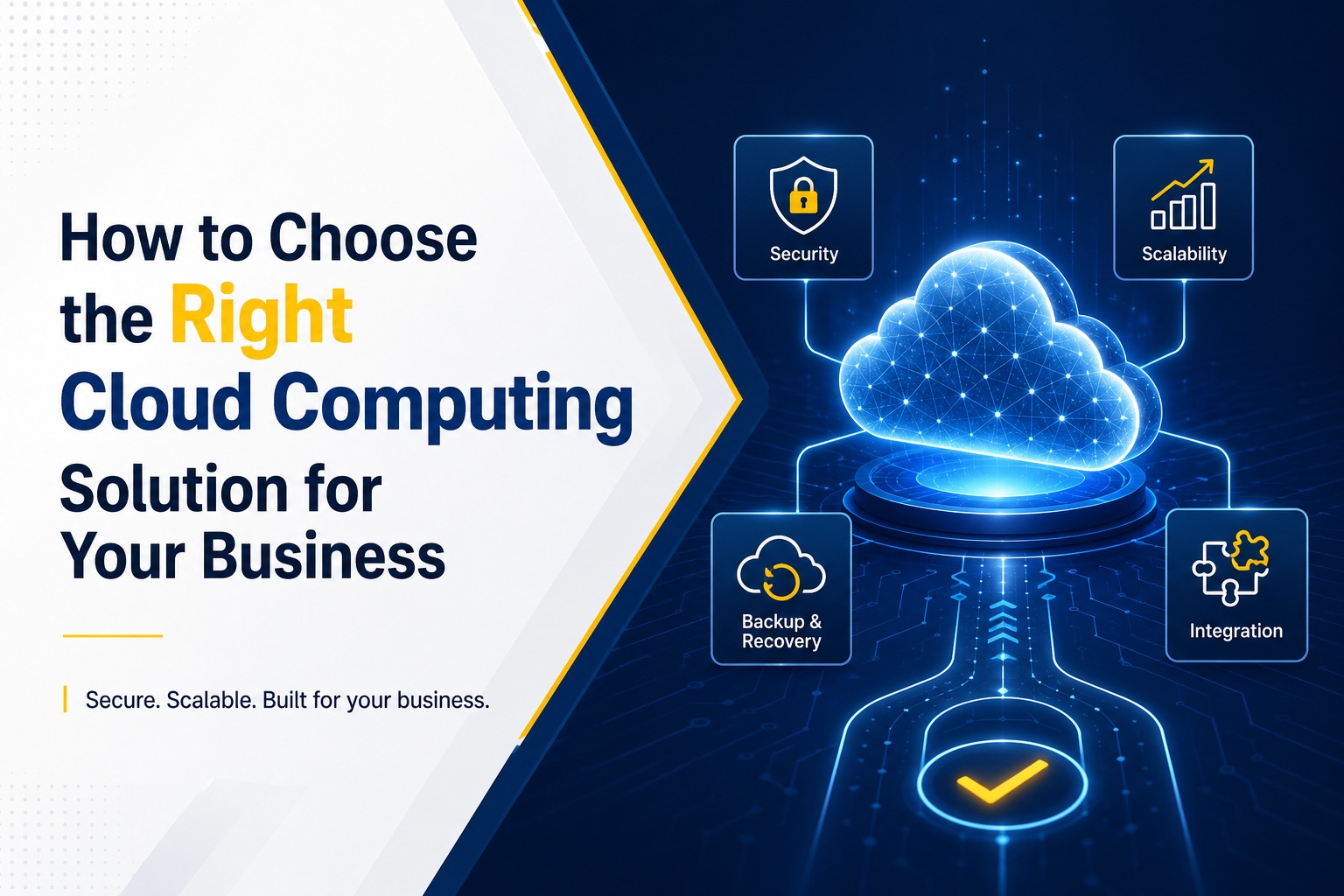
How to Choose the Right Cloud Computing Solution for Your
Business
Published by Capitol Technology Solutions | Cloud Computing | IT Strategy | Business Technology
Cloud computing has fundamentally changed the way businesses store data, run applications, and deliver services to their clients. What was once the exclusive domain of large enterprises with dedicated data centers is now accessible to businesses of every size, in every industry. From a solo consulting firm to a mid-sized healthcare organization, cloud technology offers a path to greater flexibility, lower infrastructure costs, and the kind of operational agility that modern business demands.
But with that opportunity comes a challenge that many business owners and IT decision-makers find genuinely difficult: choosing the right cloud solution. The cloud computing market is vast, crowded with vendors, and full of terminology that can feel more confusing than clarifying. Public cloud, private cloud, hybrid cloud, IaaS, PaaS, SaaS. Each option comes with its own strengths, trade-offs, pricing structures, and suitability for different types of organizations and workloads.
At Capitol Technology Solutions, we help businesses across consulting, legal, financial services, healthcare, government relations, and engineering navigate exactly this kind of decision. Choosing the right cloud strategy is not about picking the most technically impressive option. It is about finding the solution that best fits your business goals, your security requirements, your budget, and the way your team actually works. This guide walks you through everything you need to understand to make that choice with confidence.
What Is Cloud Computing and Why Does It Matter?
At its core, cloud computing means accessing computing resources, whether storage, processing power, software, or networking, over the internet rather than from hardware that sits physically in your office. Instead of buying and maintaining your own servers, you pay a cloud provider to host those resources and deliver them to you on demand.
The practical benefits of this model are significant. You only pay for what you use, which eliminates the capital expense of buying hardware that may sit underutilized for most of its life. You can scale resources up or down as your business needs change, without waiting weeks for new hardware to be purchased, shipped, and installed. Your team can access data and applications from anywhere with an internet connection, which supports remote work, collaboration across locations, and business continuity in the face of disruptions.
Cloud computing also shifts a significant portion of the responsibility for infrastructure maintenance, security patching, and hardware lifecycle management from your internal team to the cloud provider. For small and mid-sized businesses without large IT departments, this can be transformative. Rather than spending time managing servers, your IT resources can focus on the work that directly supports your business objectives.
With that foundation in place, it is time to explore the three primary clouddeployment models and what each one means for your business.
Public Cloud: Flexibility and Scale on Demand
The public cloud is what most people think of when they hear the term cloud computing. In this model, computing resources are owned and operated by a third-party cloud provider and delivered to multiple customers over the internet. The major public cloud platforms are Amazon Web Services (AWS), Microsoft Azure, and Google Cloud Platform (GCP), though dozens of other providers serve specific industries and use cases.
Public cloud services are built on a shared infrastructure model. Your data and workloads run on hardware that is also used by other organizations, though your data is logically isolated and protected from other tenants. This shared model is what allows public cloud providers to offer services at scale and at a price point that individual businesses could not achieve with dedicated infrastructure.
The advantages of the public cloud are compelling, particularly for small and growing businesses. There are no upfront hardware costs. You can provision new servers, storage, or services in minutes. The cloud provider handles all maintenance, upgrades, and physical security. And because major providers operate data centers across multiple geographic regions, their infrastructure offers a level of redundancy and uptime that most small businesses simply cannot replicate on their own.
Public cloud is an excellent fit for organizations with:
• Variable or unpredictable workloads that benefit from the ability to scale quickly
• Limited capital budgets that make large upfront hardware investments impractical
• Teams that are distributed across multiple locations or working remotely
• Standard business applications such as email, collaboration tools, CRM, and document management
• Development and testing environments where temporary resource needs fluctuate
The primary considerations with public cloud are data sovereignty and compliance. If your business operates in a regulated industry, such as healthcare under HIPAA or financial services under various data protection frameworks, you need to carefully evaluate whether a public cloud provider's compliance certifications and data handling practices meet your regulatory obligations. Most major providers have invested significantly in compliance infrastructure, but the responsibility for configuring your environment correctly rests with your organization.
Private Cloud: Control and Security for Sensitive Workloads
A private cloud is a cloud computing environment dedicated exclusively to a single organization. Rather than sharing infrastructure with other customers, a private cloud operates on hardware that is either located in your own facility, hosted in a colocation data center, or provided by a managed services partner on your behalf, but always reserved for your use only.
The defining characteristic of a private cloud is control. Your organization has full authority over the hardware, the software stack, the security configuration, and the network architecture. There are no shared tenants to worry about, and your data never resides alongside another organization's workloads. For businesses handling particularly sensitive information, such as legal firms managing privileged client communications, healthcare providers processing protected health information, or government contractors working with controlled data, this level of isolation can be essential.
Private cloud also offers greater customization. You can design your environment to meet very specific performance, compliance, or integration requirements that a public cloud's standardized offerings may not accommodate. Organizations with highly specialized applications or unique networking requirements often find that private cloud gives them the flexibility they need without the constraints of a shared platform.
Private cloud is typically a strong fit for organizations with:
• Strict regulatory or compliance requirements that demand full data isolation
• Highly sensitive data such as legal records, financial information, or protected health data
• Predictable, consistent workloads where dedicated resources are cost-effective
• Applications that require specialized hardware configurations or very low latency
• Internal policies or client contractual requirements that restrict third-party data hosting
The trade-off with private cloud is cost and operational complexity. Maintaining a private cloud environment requires either a capable internal IT team or a trusted managed services partner. The upfront investment in hardware and configuration is higher than public cloud, and you bear responsibility for maintenance, security, and capacity planning. For businesses that require this level of control, those costs are justified. For businesses that do not have strict isolation requirements, public or hybrid cloud models often deliver better value.
Hybrid Cloud: The Best of Both Worlds
As the name suggests, a hybrid cloud environment combines elements of both public and private cloud, allowing organizations to run different workloads in different environments based on what makes the most sense for each. A typical hybrid cloud setup might keep sensitive client data and mission-critical applications on a private cloud infrastructure while using public cloud services for less sensitive workloads, collaboration tools, backup storage, or development environments.
The appeal of hybrid cloud is its flexibility. Rather than forcing every workload into a single environment, hybrid cloud lets you optimize the placement of each application and dataset based on its specific requirements for security, performance, compliance, and cost. Sensitive data stays where it needs to stay, while everything else benefits from the scale and economics of public cloud.
Hybrid cloud is also well suited to businesses that are in the process of modernizing their IT infrastructure. Many organizations have significant investments in on-premise systems that cannot be migrated to the cloud overnight. A hybrid approach allows them to extend the life of those systems while gradually moving workloads to the cloud at a pace that makes operational and financial sense.
Hybrid cloud tends to be a strong fit for organizations with:
• A mix of sensitive and non-sensitive workloads with different security requirements
• Existing on-premise infrastructure that is not yet ready for full cloud migration
• Seasonal or variable demand spikes where public cloud burst capacity adds value
• Compliance requirements that mandate certain data remain on dedicated infrastructure
• Long-term cloud migration strategies that require a phased transition
Managing a hybrid cloud environment effectively requires careful attention to integration between the private and public components, consistent security policies across both environments, and clear visibility into performance and cost across the entire infrastructure. These are areas where working with an experienced IT partner pays significant dividends.
Understanding Cloud Service Models: IaaS, PaaS, and SaaS
Beyond deployment models, cloud computing is also categorized by service models that describe how much of the technology stack the cloud provider manages on your behalf. Understanding these distinctions helps clarify exactly what you are buying when you invest in cloud services.
Infrastructure as a Service (IaaS) provides the foundational building blocks of computing on demand. With IaaS, the cloud provider supplies virtualized hardware including servers, storage, and networking, while your organization is responsible for everything that runs on top of that hardware, including the operating system, middleware, and applications. IaaS gives you maximum control and flexibility but also requires the most technical expertise to manage effectively. AWS EC2, Microsoft Azure Virtual Machines, and Google Compute Engine are examples of IaaS offerings.
Platform as a Service (PaaS) takes a higher level of abstraction. The cloud provider manages the underlying infrastructure and the operating system, and your organization focuses on deploying and managing applications. PaaS is particularly popular with development teams because it removes the overhead of managing servers and lets developers focus entirely on building and running software. Microsoft Azure App Service and Google App Engine are common PaaS examples.
Software as a Service (SaaS) is the model most familiar to everyday business users. With SaaS, the cloud provider manages everything, including the infrastructure, platform, and the application itself. You simply log in and use the software. Microsoft 365, Google Workspace, Salesforce, and countless other business applications are delivered as SaaS. For most small and mid-sized businesses, SaaS represents the majority of their cloud spending and the cloud model they interact with most directly.
Key Factors to Consider When Choosing Your Cloud Strategy
With a clear understanding of the deployment models and service types, you are ready to think through the specific factors that should guide your organization's cloud decision. Every business is different, and the right cloud strategy depends on a combination of variables that are unique to your situation.
Security and compliance requirements should be your starting point. What data does your business collect, store, and process? What regulatory frameworks apply to your industry? What are your clients' expectations around data handling? The answers to these questions will quickly narrow your options and clarify whether a public, private, or hybrid approach is appropriate.
Cost structure and budget are equally important. Public cloud services are typically priced on a consumption basis, which is excellent for variable workloads but can become expensive if not managed carefully. Private cloud involves higher upfront costs but more predictable ongoing expenses. Understanding your workload patterns and doing a genuine total cost of ownership analysis, rather than just comparing monthly subscription prices, will lead you to a more accurate picture of what each option actually costs.
Scalability needs reflect how your business is likely to grow and change. If you anticipate significant growth, seasonal demand spikes, or the need to launch new services quickly, the elastic scalability of public cloud may be a major advantage. If your workloads are stable and predictable, the scalability premium of public cloud may not be worth paying for.
Integration with existing systems is often an underestimated factor. The best cloud solution in the abstract may not be the best solution for your business if it does not integrate well with the software and workflows you already rely on. Evaluating compatibility and migration complexity upfront prevents costly surprises during implementation.
Performance and reliability requirements vary significantly by workload. Applications that require extremely low latency or very high availability may be better served by private infrastructure. Applications where occasional brief outages are acceptable can tolerate the trade-offs of public cloud shared infrastructure.
The Importance of an Expert Cloud Migration Partner
Choosing the right cloud model is only the first step. Implementing your cloud strategy successfully requires careful planning, technical expertise, and ongoing management to ensure that your environment performs as expected, remains secure, and continues to deliver value as your business evolves.
Cloud migrations that are rushed or poorly planned consistently produce disappointing results. Applications that were not designed with cloud architecture in mind may perform poorly in a new environment. Security configurations that seem straightforward can contain subtle gaps that expose sensitive data. Cost management in the cloud requires active monitoring and governance, or bills can escalate well beyond initial estimates.
Working with a managed services partner who has deep experience in cloud strategy and implementation gives you access to expertise that most small and mid-sized businesses do not maintain in-house. The right partner will help you assess your current infrastructure, define a cloud strategy aligned with your business goals, plan and execute a migration that minimizes disruption, configure your environment for security and compliance, and provide ongoing management and support so that your cloud investment continues to deliver.
How Capitol Technology Solutions Guides Your Cloud Journey
At Capitol Technology Solutions, cloud strategy and implementation are core parts of what we do for clients across a wide range of industries. We understand that no two businesses have identical needs, and we do not believe in pushing clients toward a particular cloud model because it is convenient for us. We start every engagement by listening carefully to what you are trying to achieve, what constraints you are working within, and what your team's experience with technology looks like today.
From there, we help you build a cloud roadmap that is realistic, financially sound, and genuinely aligned with where you want to take your business. Whether that means migrating your entire infrastructure to Microsoft Azure, building a hybrid environment that keeps sensitive data on private infrastructure while leveraging public cloud for collaboration and productivity, or simply starting with SaaS solutions that eliminate the burden of on-premise software management, we bring the expertise and the commitment to make it work.
Our network design, software solutions, managed services, and data security capabilities mean that we can support every layer of your cloud environment, not just the initial migration but the long-term management that ensures your investment keeps paying off. We monitor your environment around the clock, apply patches and updates proactively, and give you clear visibility into performance, security, and costs so that there are never any surprises.
The cloud is not a destination. It is an ongoing capability that evolves alongside your business. Getting the foundation right from the start makes all the difference. If you are ready to explore what the right cloud strategy looks like for your organization, our team is here to help you figure it out.