AI Governance for Small and Mid-Sized Businesses What Policies Do You Actually Need
Your employees may already use artificial intelligence to draft emails, summarize meetings, analyze spreadsheets, write code, research topics, create presentations, and respond to customers.
Some may use company-approved platforms. Others may open personal accounts or install AI-enabled browser extensions without asking IT.
The productivity benefits are real. So are the questions. What information can employees enter? Which tools are approved? Who checks the output? Can AI be used for hiring, legal work, financial decisions, or client communication? What happens if someone accidentally shares confidential data?
Businesses seeking AI Consulting Services in Washington DC often assume they need either a complicated governance program or a complete ban. Most small and mid-sized organizations need neither. They need clear rules that match their actual risks, data, tools, people, and business goals.
A practical AI governance program helps employees use AI productively while protecting confidential information, customer trust, security, and decision quality.
The goal is not to slow innovation. It is to prevent useful experimentation from becoming unmanaged business risk.
What Is AI Governance?
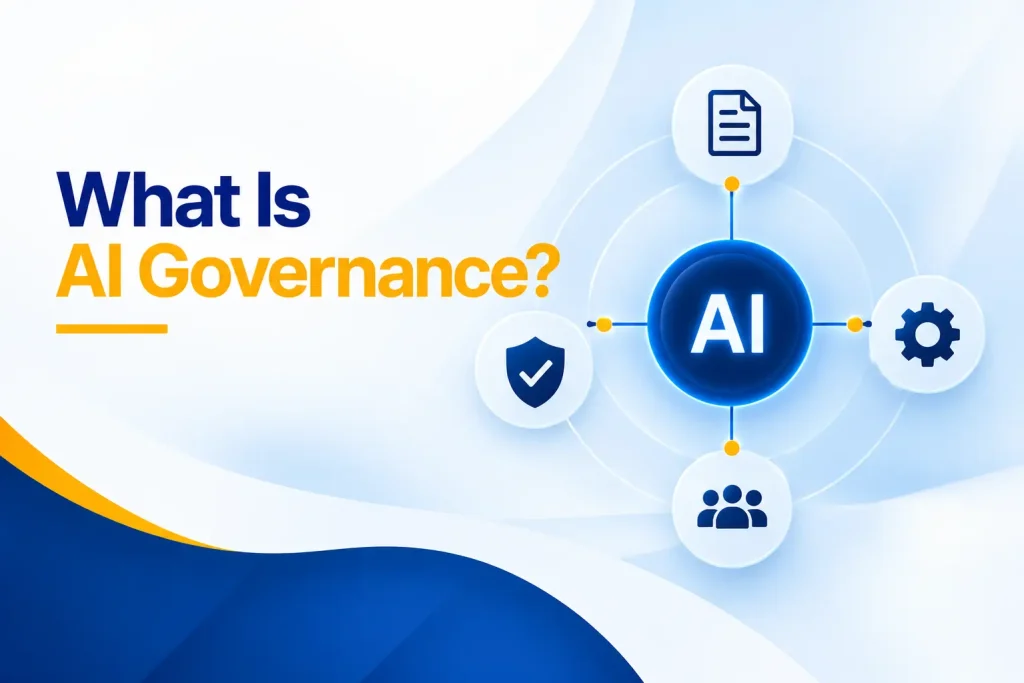
AI governance is the system a business uses to decide how artificial intelligence may be selected, configured, accessed, monitored, and used.
It includes written policy, but it is broader than a document. Governance also covers ownership, approvals, technical controls, training, risk reviews, vendor management, incident response, and ongoing oversight.
Good governance should answer:
● Which AI tools may employees use?
● Which business activities may those tools support?
● What data may or may not be entered?
● When is human review required?
● Which AI uses require additional approval?
● Who owns each decision and system?
● How are problems reported and investigated?
● How often are tools, risks, and policies reviewed?
The NIST AI Risk Management Framework provides a useful foundation. It organizes AI risk management around four functions: Govern, Map, Measure, and Manage.
Small businesses can adapt these ideas without implementing every possible process or creating a large governance department.
NIST’s Generative AI Profile adds guidance for risks that are especially relevant to generative AI, including unreliable output, information security, privacy, intellectual property, and harmful bias.
Why Small and Mid-Sized Businesses Need an AI Policy
AI use becomes a business issue as soon as an employee uses it for company work. Occasional use can still involve sensitive data, inaccurate output, intellectual property, biased recommendations, or unapproved software.
Common risks include:
● Employees entering customer, employee, financial, legal, or security information into unapproved tools
● AI-generated content containing errors, fabricated facts, or misleading citations
● Confidential documents being processed through personal accounts
● Browser extensions or integrations receiving broad access to email and cloud files
● AI-generated code introducing security or licensing problems
● Employees sending AI-generated material without meaningful review
● Automated recommendations influencing hiring or other important decisions
● The business being unable to identify which tools are in use
An AI policy for small business should reduce uncertainty. Employees should not need to guess whether a common task is allowed or whom to ask for approval.
The policy also protects productive use. When employees have approved tools and clear boundaries, they are less likely to hide their activity or turn to unmanaged alternatives.
Do You Need Several AI Policies?
Most smaller organizations do not need a separate document for every risk. They can begin with one central AI governance policy supported by a few existing business processes.
The practical minimum usually includes:
● A business AI policy that defines purpose, scope, ownership, and general rules
● An AI acceptable use policy that tells employees what they may and may not do
● Data-handling rules connected to existing information classifications
● A process for reviewing and approving AI tools, vendors, extensions, and integrations
● Human-review requirements for important or external-facing work
● A reporting process for mistakes, suspicious output, or unintended disclosure
These elements may exist in one concise policy or across several existing policies.
For example, the acceptable-use section could be added to the employee handbook, while technical approval requirements sit within the IT procurement process.
The format matters less than clarity. Employees and managers must be able to find, understand, and apply the rules.
What Should an AI Governance Policy Include?
A useful policy should be specific enough to guide real decisions but flexible enough to survive changes in products and features.
Avoid writing it around one chatbot alone. AI capabilities now appear in email, meetings, productivity software, customer platforms, security tools, creative applications, and business systems.
1. Purpose and Scope
Explain why the policy exists and who it covers. Include employees, contractors, temporary workers, consultants, and any other person using AI for the organization.
Define AI broadly enough to include:
● Public generative AI tools
● Enterprise AI assistants
● AI features built into existing software
● Meeting transcription and summarization tools
● Browser extensions and plug-ins
● AI agents and automated workflows
● Machine-learning systems used for recommendations or decisions
The scope should cover company devices, personal devices used for work, company accounts, and personal accounts used for business activity.
2. Approved Tools and Accounts
State that employees may use only tools approved for the intended business purpose.
Approval should consider the provider, account type, contract, settings, data practices, security capabilities, integrations, and the information being processed.
Require company-managed accounts where possible. Personal and free accounts may have different controls, retention options, administration, and contractual protections than business offerings.
Do not assume that every product from the same provider handles data identically.
OpenAI explains that data from covered business offerings is not used to train its models by default in its enterprise privacy commitments.
Microsoft also documents specific protections and data-handling practices for Microsoft Copilot Chat.
Those commitments apply to the products, accounts, terms, and configurations described by each provider. They do not automatically apply to every AI tool.
3. Data Classification and Prohibited Information
Connect AI use to the business’s existing data classifications. If formal categories do not exist, create simple levels such as public, internal, confidential, and restricted.
Employees should never enter passwords, authentication codes, private keys, API secrets, or other credentials into an AI prompt.
An unapproved public tool should also not receive:
● Customer or client records
● Personal employee information
● Financial statements and unreleased results
● Contracts, legal advice, or negotiation strategy
● Healthcare, payment, or regulated information
● Proprietary source code
● Security reports, vulnerabilities, or network details
● Trade secrets, research, and product plans
● Confidential meeting transcripts
● Information protected by client agreements
Removing a name may not be enough. Details in a document can still identify a person, client, matter, or company when combined.
4. Acceptable and Prohibited Uses
An AI acceptable use policy should give practical examples rather than relying on a vague instruction to “use AI responsibly.”
Lower-risk uses may include brainstorming with public information, improving the tone of non-confidential text, creating a first draft from approved material, or summarizing content already cleared for the tool.
Uses that may require additional review include:
● Customer communication
● Analysis of internal information
● Software development
● Marketing claims
● Translations
● Contract summaries
● Work that could affect a client decision
The policy may prohibit employees from using unapproved AI to make final decisions about hiring, termination, promotion, credit, healthcare, legal strategy, safety, or other high-impact matters.
It should also prohibit attempts to bypass security controls, impersonate people deceptively, create unlawful content, expose confidential data, or connect unauthorized AI agents to business systems.
5. Human Review and Accountability
AI can produce fluent answers that are inaccurate, incomplete, biased, outdated, or unsupported.
A person must remain responsible for work produced with AI assistance. The policy should require employees to review:
● Facts, calculations, and dates
● Sources and citations
● Confidential or personal information
● Legal, regulatory, and contractual implications
● Bias or unfair assumptions
● Copyright and ownership concerns
● Security weaknesses in generated code
● Tone, context, and suitability for the audience
The level of review should match the potential harm.
A brainstorming list needs less oversight than legal advice, financial analysis, a hiring recommendation, or material sent to a customer.
6. High-Impact Decisions
AI deserves additional scrutiny when its output can affect a person’s employment, finances, healthcare, legal rights, access to services, or safety.
For example, an HR team may use AI to organize applications. However, the business should understand the system’s data, logic, limitations, and potential for unfair outcomes before allowing it to influence candidate selection.
The U.S. Equal Employment Opportunity Commission explains that federal employment discrimination protections can apply when automated systems are used in workplace decisions.
Its guidance on the EEOC’s role in AI helps explain why human oversight and careful review matter.
Policies should require executive, HR, legal, privacy, or other appropriate approval before adopting high-impact uses.
The exact review depends on the industry, location, use case, and applicable obligations.
7. Transparency and Disclosure
Define when employees must disclose that AI helped create content or support a decision.
Internal brainstorming may not require a label. Client deliverables, regulated communications, research, or synthetic media may require disclosure or approval.
Employees should not present invented sources, AI-generated analysis, or synthetic evidence as independently verified work.
The organization should also decide whether customers, job candidates, or other affected people need to know when they are interacting with AI or when AI materially influences a process.
8. Vendor and Tool Approval
Before approving an AI platform, review more than its visible features. Ask:
● Is business data used to train or improve models?
● How long are prompts, files, and responses retained?
● Can administrators control access and delete information?
● Does the service support single sign-on and multifactor authentication?
● What logs and monitoring are available?
● Which sub processors or third parties receive data?
● Where is information processed and stored?
● What happens when an employee leaves?
● Can plug-ins or agents connect to other business systems?
● How does the provider report security incidents?
● What happens to data when the agreement ends?
The Federal Trade Commission has emphasized that AI providers must honor their privacy and confidentiality commitments.
Its guidance on AI privacy and confidentiality claims reinforces why businesses should review actual terms and controls rather than rely only on marketing statements.
9. Security for Integrations and AI Agents
The risk increases when AI can search company files, access email, update customer records, run code, send messages, or perform actions automatically.
Apply least privilege. Give the tool only the data and permissions required for its approved purpose.
Separate testing from production, protect API credentials, limit autonomous actions, and require human approval for sensitive changes.
Monitor connections and remove unused access. An abandoned integration can remain a path into business information long after the original experiment ends.
CISA’s artificial intelligence resources collect guidance for secure AI development and deployment.
Small businesses may not build their own models, but the security principles still matter when connecting AI services to company systems and data.
10. Reporting and Incident Response
Employees need a simple, blame-free way to report mistakes.
They should know whom to contact if they enter confidential information, receive suspicious AI output, expose credentials, install an unapproved extension, or discover an unsafe integration.
The response may include:
● Preserving the relevant prompt, output, account, and timestamps
● Identifying the information involved
● Changing exposed passwords, keys, or tokens
● Removing access granted to an integration
● Using available provider deletion controls
● Reviewing logs and connected systems
● Contacting the vendor when necessary
● Involving security, privacy, legal, HR, or leadership
● Documenting lessons and updating controls
Fast reporting gives the business more options. A policy that punishes honest mistakes may cause employees to hide problems until the impact grows.
A Practical AI Governance Framework for Small Business
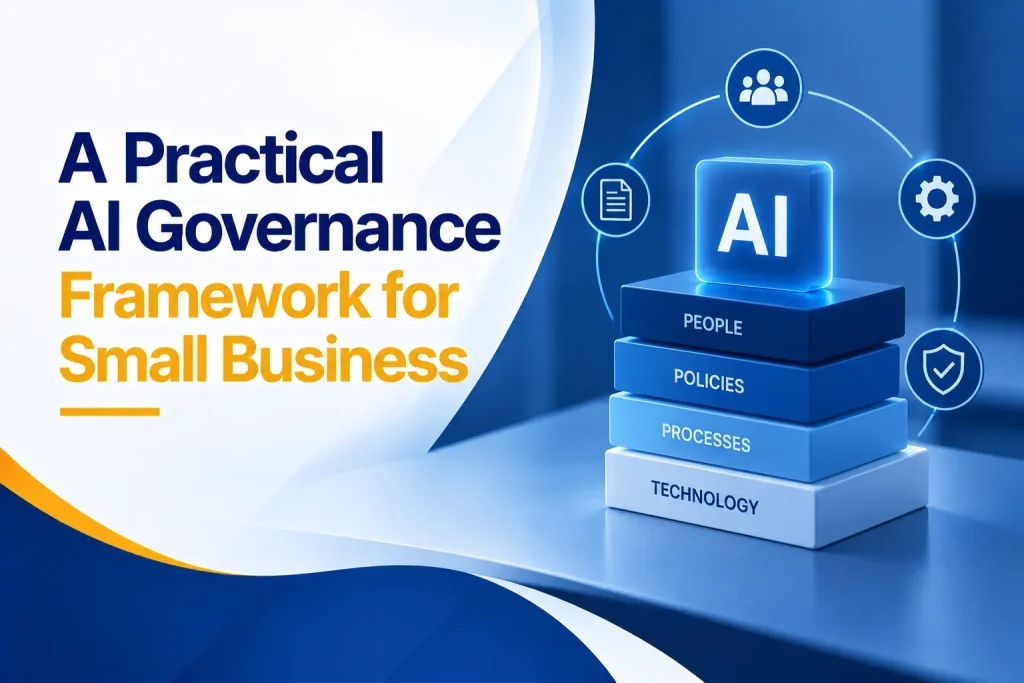
An AI governance framework for small business should be proportionate.
A 40-person company does not need the same committee structure as a global enterprise. However, it still needs ownership and repeatable decisions.
The NIST approach can be translated into four practical activities.
Govern the Use of AI
Assign an executive owner. Approve the policy, define responsibilities, set risk tolerance, and decide which uses require additional review.
Governance also means connecting AI with existing security, privacy, HR, legal, procurement, and incident-response processes.
Map Tools, Data, and Business Impact
Identify which tools employees use, what data they receive, what outputs they create, and which business processes depend on them.
Consider who could be affected if the output is wrong or if the data is exposed.
A writing assistant using public information carries different risks from an agent connected to email, accounting, or customer records.
Measure the Risk and Performance
Test whether the tool performs well enough for the intended task. Examine accuracy, security, privacy, bias, reliability, permissions, and failure scenarios.
Do not evaluate the model alone. Review the complete workflow, including prompts, data sources, integrations, employee decisions, and downstream actions.
Manage the Risk Over Time
Approve, restrict, redesign, or reject the use based on the findings.
Apply controls, train users, monitor results, and reconsider the decision when the provider, model, data, integration, or business purpose changes.
The NIST AI RMF Playbook offers voluntary suggested actions under Govern, Map, Measure, and Manage.
Organizations can select the practices that fit their use cases rather than treating the entire resource as a mandatory checklist.
Should You Block Public AI Tools?
A complete ban can be appropriate for certain environments, data categories, roles, or devices.
However, blocking every public AI service may push employees toward personal phones, home computers, or tools that are even harder to see.
A more practical approach is usually to:
● Provide an approved business-grade tool for legitimate work
● Require company-managed accounts
● Block clearly unsuitable or high-risk services
● Prevent restricted data from being uploaded where possible
● Limit risky extensions, plug-ins, and integrations
● Monitor the use of unsanctioned applications
● Train employees with examples they recognize
● Create a quick process for requesting new tools or use cases
Technical controls should support the policy. They cannot replace understandable rules, useful approved options, and responsible management.
Who Should Own AI Governance?
A small business should name one accountable executive.
That person does not need to be an AI engineer, but they must be able to coordinate decisions and escalate concerns.
Responsibilities may be divided as follows:
● Leadership sets priorities, approves risk, and provides resources
● IT and security evaluate tools, access, integrations, and technical controls
● Legal or privacy advisers review contracts, data obligations, and high-risk uses
● HR addresses employee guidance, training, and employment-related systems
● Department managers approve use cases and verify that human review occurs
● Employees follow the rules and report concerns promptly
One person may hold several roles in a smaller organization.
The essential point is that ownership is documented. AI governance fails when everyone assumes someone else is reviewing the tool.
How to Build a Responsible AI Policy in 30 Days
A responsible AI policy does not need to take a year to launch.
A focused first version can be created quickly and improved as the business learns.
Week 1: Discover Current AI Use
Survey employees and managers. Review browser extensions, software inventories, expense records, connected applications, and planned projects.
Ask people how AI helps them and what information they enter.
The goal is visibility, not punishment. Employees are more likely to disclose shadow AI use when the organization explains that it wants to provide safer tools.
Week 2: Approve Tools and Define Boundaries
Select initial approved tools and account types.
Define prohibited data, acceptable uses, human-review requirements, and activities that need additional approval.
Keep the first business AI policy concise. It should answer the questions employees face most often.
Week 3: Configure Controls and Train Employees
Enable available identity, access, retention, privacy, security, and logging controls. Remove unapproved integrations and restrict unnecessary access.
Train employees using examples from their roles. Marketing, finance, HR, legal, operations, development, and client-service teams do not use AI in the same way.
Week 4: Test the Process
Ask employees to submit sample tool requests.
Test how the organization responds to accidental data exposure and how managers review AI-assisted work.
Record unresolved risks, assign owners, and schedule the first policy review.
Governance becomes real when people can follow the process, not merely when the document is published.
Common AI Governance Mistakes
Avoid these common problems:
● Writing a policy without discovering how employees already use AI
● Banning one well-known chatbot while ignoring embedded AI and extensions
● Treating every use case as equally risky
● Allowing personal accounts for confidential business work
● Assuming an enterprise license makes every workflow safe
● Approving tools without reviewing integrations and permissions
● Using vague language without practical examples
● Failing to define who owns decisions
● Allowing AI output to reach customers without suitable review
● Forgetting contractors and temporary workers
● Treating policy publication as the end of the project
● Ignoring changes in provider terms, features, or data practices The best program is not the one with the longest policy.
It is the one employees can follow and leadership can enforce consistently.
How AI Consulting Services in Washington DC Can Help
Capitol Technology can help small and mid-sized businesses turn AI use into a manageable, secure business process.
Our approach begins with the organization itself. We review employee use, approved and unapproved applications, sensitive data, cloud systems, identity controls, business workflows, vendor terms, and planned AI projects.
Through our managed IT services, we can help businesses inventory technology, manage accounts and devices, review applications, improve access control, and support practical technology governance.
Our data and network security services can help strengthen data protection, identity security, monitoring, endpoint controls, incident readiness, and the technical safeguards surrounding AI use.
AI Consulting Services in Washington DC should not deliver a generic policy copied from another organization.
Your policy should reflect your people, clients, contracts, systems, data, industry, and appetite for risk.
The result should be clear: employees know which tools they can use, managers know what requires approval, and leadership can adopt AI without losing control of business information.
Conclusion
Small and mid-sized businesses do not need to choose between uncontrolled AI use and a complete ban.
Start with one clear AI governance policy. Define approved tools, prohibited data, acceptable uses, human-review requirements, vendor approval, security controls, ownership, and reporting.
Then apply stronger review to higher-risk activities.
The policy should support useful work while setting boundaries employees understand. It should also change as the business adopts new tools, connects AI to more data, and learns from real use.
For organizations evaluating AI Consulting Services in Washington DC, the right objective is practical governance rather than paperwork.
A well-designed program helps the business use AI confidently while protecting data, decisions, customers, and long-term trust.
Ready to create an AI policy that fits the way your employees actually work? Contact Capitol Technology for an AI governance and security assessment tailored to your business.
Frequently Asked Questions
Does My Small Business Really Need an AI Policy if Employees Only Use ChatGPT Occasionally?
Yes. Occasional use can still expose confidential data or introduce inaccurate content into business work.
The policy can be short and proportionate. At minimum, define approved accounts, prohibited information, acceptable uses, human-review requirements, and a reporting contact.
What Information Should Employees Never Put Into ChatGPT or Other AI Tools?
Employees should never enter passwords, authentication codes, API keys, private encryption keys, or other credentials.
They should also avoid entering customer information, personal data, contracts, legal advice, financial records, proprietary code, security details, trade secrets, and other confidential information unless the organization has specifically approved the tool, account, data category, and use case.
What Should a Basic AI Acceptable Use Policy Include?
It should identify approved tools and accounts, permitted tasks, prohibited information, high-risk activities, human-review responsibilities, security requirements, disclosure expectations, and reporting steps.
Include practical examples so employees can apply the rules to everyday work.
Do We Need to Block Employees From Using Public AI Tools?
Not always. Some organizations need strict blocking because of their data or regulatory environment.
Others can permit limited low-risk use while blocking sensitive uploads and providing an approved business platform.
The decision should reflect the data, role, tool, account type, and business purpose.
Who Should Be Responsible for AI Governance in a Small Business?
Assign one accountable executive and support that person with relevant input from IT, security, HR, legal, privacy, and department managers.
In a smaller company, one person may perform several roles. Responsibilities and approval authority should still be documented clearly.